When the Couch Doesn't Fit, the Magic Happens: The Creative Power of Wrong Furniture
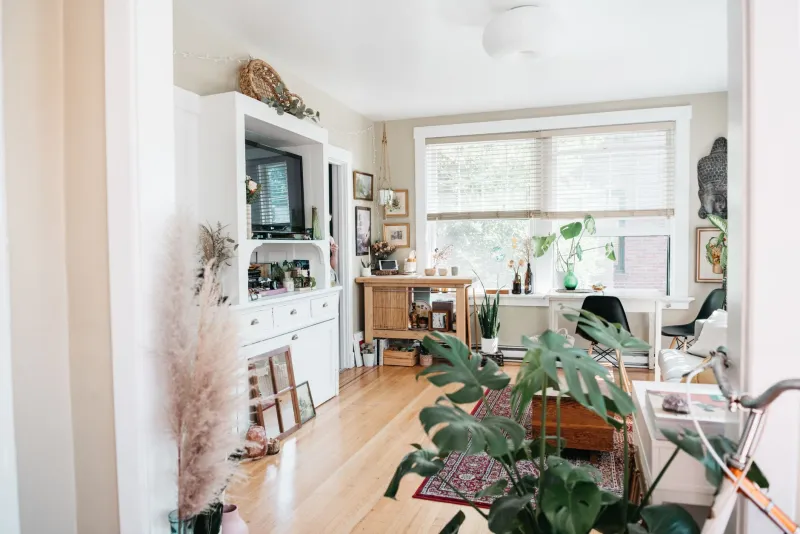
There's a particular kind of apartment shame most of us have felt at least once. You know the one. A guest walks through your door, clocks the enormous velvet armchair that takes up roughly 40 percent of your studio, and their face does that thing — that polite, almost imperceptible recalibration. You launch into the explanation before they can say anything. I know, I know. It's too big. I got it at an estate sale and I couldn't leave it behind.
Here's the thing, though: stop apologizing. That chair might be the most important object in your apartment. Not despite the fact that it doesn't fit — because of it.
The Tyranny of the Perfectly Scaled Room
Contemporary design culture has a deep, abiding love affair with proportion. Scroll through any major home decor platform for about thirty seconds and you'll be swimming in airy, calibrated rooms where every piece of furniture seems to have been selected by a benevolent algorithm. The rug is always the right size. The sofa never overwhelms. The negative space is practically doing yoga.
It's beautiful. It's also, for a lot of people, completely deadening.
Minimalism as a design philosophy carries a quiet assumption baked into it: that clarity of space produces clarity of mind, and clarity of mind produces good work. And sure, for some people that's true. But there's a growing counter-argument — louder now than it's been in years — that constraint, friction, and the sheer physical negotiation of living with wrong objects might actually be what shakes creative thinking loose.
Brooklyn-based illustrator and muralist Dara Okonkwo knows this firsthand. Her Bushwick apartment is home to a dining table that comfortably seats ten people in a room that comfortably seats six. She didn't plan it that way.
"I inherited it from my aunt," she says. "It's this massive mid-century thing, solid walnut, and it literally cannot leave the apartment because we'd have to take a wall down. So it just... lives here. It dominates everything."
At first, she resented it. Then something shifted.
"I started spreading my work across the whole surface. Sketches on one end, reference materials in the middle, coffee at the other end. I stopped working small. The table kind of demanded that I scale up, and my work got bigger — literally and figuratively. I think about that table all the time now when I'm in a creative rut. I ask myself, what would the table do?"
Friction as a Feature
There's a concept in cognitive science called desirable difficulty — the idea that learning and creative thinking are actually enhanced when conditions are slightly harder than ideal. Psychologists have documented it in academic contexts for decades, but designers and artists have been living it intuitively forever.
When your furniture fits perfectly, your apartment becomes a solved problem. Everything is where it should be. Your body moves through the space on autopilot. Your brain, bless its efficiency-obsessed little heart, stops paying attention.
But when the bookshelf is too tall and you have to drag a step stool over every time you want something from the top shelf, you notice the bookshelf. When the armchair sits at a weird angle because the coffee table is technically too large for the room, you make choices about where to sit, how to position your body, how to orient yourself toward the window or the wall. You're present in the space in a way that a perfectly arranged room simply doesn't require.
San Francisco-based musician and producer Theo Villanueva describes his home studio setup as "aggressively incorrect."
"I have this ancient upright piano that's slightly out of tune and I refuse to get it fixed," he says. "And I have a synth rack that's too wide for the alcove it's in, so I've got it sitting at an angle with one side propped up on a book. None of it is how it's supposed to be."
He grins when he talks about it. "But I've written some of my best stuff in that room. I think it's because nothing lets me coast. The piano doesn't let me play the easy thing. The synth setup means I'm always reaching, always adjusting. It keeps me in this slightly uncomfortable, slightly alert state. That's where I do my work."
The Object That Changes the Room's Personality
There's also something worth considering about what wrong furniture does to the social and emotional character of a space. A room that's been expertly styled often communicates a kind of completion — a finished thought. Which is lovely for a hotel lobby but can feel weirdly static for a place where actual human life is supposed to unfold.
A too-large couch, a dresser that's technically a dining room piece, a coffee table that used to be a door — these objects carry stories. They generate questions. They make a room feel inhabited rather than installed.
Interior designer and writer Camille Stroud, who runs a small practice out of Chicago focused on what she calls "lived-in modernism," argues that the most interesting rooms she's ever encountered have always had at least one piece that breaks the logic of the space.
"I call it the rogue object," she says. "Every great room has one. It's the thing that makes you stop and go, wait, why is that here? And then the room opens up. You start seeing everything differently because that one piece has disrupted your assumptions."
She's deliberately started incorporating rogue objects into her client projects — suggesting an oversized vintage mirror for a narrow hallway, or a long farmhouse bench in a sleek, modern kitchen. The clients are often nervous at first. They come around.
"Once people stop trying to make everything match and start letting things be in conversation with each other — even an argumentative conversation — the space becomes theirs. Really theirs."
Learning to Live With the Argument
Maybe that's the real point. A room full of furniture that fits perfectly is a room that's already made up its mind. But a room where the daybed is slightly too long, where the vintage credenza sits in mild visual tension with the modern sofa, where the lamp is frankly ridiculous but you love it anyway — that room is still thinking. Still working something out.
And if you live inside that argument long enough, you start thinking along with it.
Dara Okonkwo put it best, sitting at her enormous walnut table with a cup of coffee and a spread of sketches that covered half the surface.
"The furniture that doesn't fit is the furniture that makes you figure something out," she said. "And figuring something out is basically just another word for being creative."
So the next time someone gives you that look — the polite, recalibrating look — just smile. You don't need to explain the chair. The chair is doing exactly what it's supposed to do.