Big Couch, Small Room, Zero Apologies: The Anti-Design Movement Living in Your Floor Plan
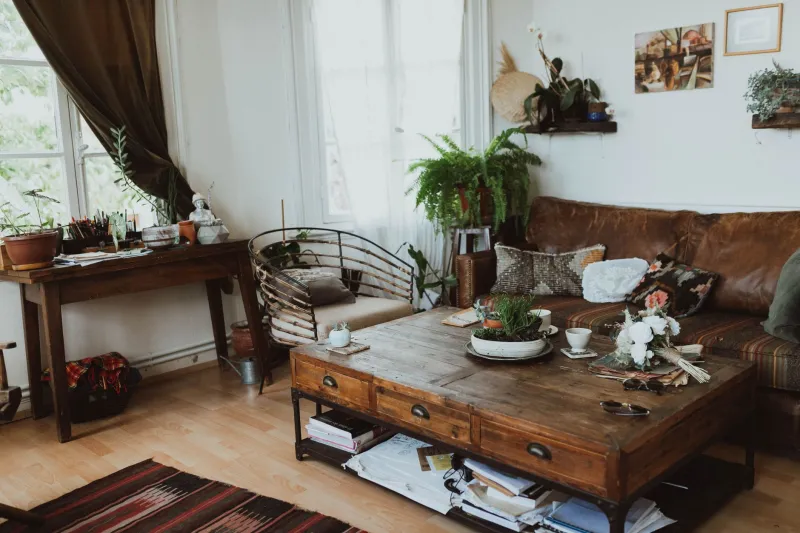
There's a rule somewhere — written in the fine print of every interior design magazine, every Pinterest board, every HGTV segment — that says your furniture must fit your space. Proportionally. Sensibly. Politely. The rug should float two inches from the wall. The sofa should leave a clear path to the window. The coffee table should be reachable from every seat without requiring anyone to lean uncomfortably forward.
And then there are people like Maya Torres, who bought a nine-foot velvet sectional for her 480-square-foot studio in Chicago and has never once regretted it.
"People walk in and their first reaction is always like, 'Oh,'" she laughs. "That little pause. And then they sit down, and they never want to leave."
Maya isn't an outlier. She's a pioneer.
The Rule Book Nobody Asked For
Conventional furniture arrangement wisdom has been drilled into renters for decades: scale your pieces to your room, keep traffic lanes clear, choose a focal point and build outward. These aren't bad guidelines, exactly. They're just guidelines built for a fantasy apartment — the kind with even walls, logical room shapes, and ceilings that don't drop two feet right where you'd naturally want to put a floor lamp.
But most apartments, especially in older American cities, don't live in that fantasy. They live in converted pre-war buildings with radiators in the wrong corners, L-shaped rooms that make no geometric sense, and doorways positioned as if the architect was actively trying to ruin your furniture arrangement. The rules were never written for these spaces. And increasingly, the people living in them are done pretending otherwise.
Design writers have started paying attention. What's emerging online — across Reddit's r/malelivingspace and r/femalelivingspace, across TikTok apartment tours, across the accounts of micro-influencers in Brooklyn and Denver and Austin — is a kind of joyful defiance. Oversized pieces crammed into small rooms. Tiny accent chairs marooned in the center of large ones. Dining tables pushed against windows so that every meal becomes a window seat situation. Mismatched woods, clashing legs, inherited pieces that fight with everything else and somehow win.
Call it anti-design. Call it wrong-furniture-right-feeling. Call it whatever you want — it's becoming one of the most authentic aesthetic movements happening in American homes right now.
The Oversized Couch as a Political Act
There's something quietly radical about choosing comfort over convention in a space you're renting for more money than your parents paid for their first mortgage. Maya's sectional isn't just furniture. It's a declaration that this apartment — temporary, imperfect, slightly too loud from the street — is going to feel like hers regardless.
"I spent the first two years in apartments trying to make them look like they were supposed to look," she says. "Buying the right-sized everything, keeping it minimal. And I was miserable. The spaces felt like hotel rooms. Like I was a guest in my own life."
The sectional changed that. It takes up roughly 60 percent of her main living area. You have to edge around it to get to the kitchen. Her friends have to coordinate who sits where before everyone sits down. And somehow, that has made the apartment more social, more alive, more used than any carefully scaled loveseat ever did.
This tracks with what some designers are now calling "friction furniture" — pieces that require you to engage with a space rather than move through it invisibly. When your furniture demands negotiation, it creates intimacy. Awkward, yes. But the good kind.
Small Pieces in Big Rooms: The Other Direction
The anti-design movement doesn't only run oversized. James Okafor lives in a two-bedroom in Atlanta with ceilings so high they make every piece of furniture look like a dollhouse accessory. His response wasn't to buy bigger — it was to lean in.
"I have this tiny little bistro table in my dining area," he says. "It seats two people, barely. In this enormous room with twelve-foot ceilings. And everyone always comments on it."
The effect, James admits, is slightly surreal. A little theatrical. Like having dinner on a stage. But it's also created a ritual around meals — the table is intimate by necessity, conversations are close, and the vast empty ceiling above them feels less like a flaw and more like atmosphere.
"A friend of mine called it 'intentional absurdity,'" he says. "I think that's exactly right."
When Mismatched Becomes the Point
Beyond scale, there's the question of cohesion — or the deliberate lack of it. The inherited grandmother's armchair that clashes with the mid-century media console. The industrial metal shelving in an otherwise warm, textile-heavy room. The dining chairs that are all different because they were collected one at a time from estate sales and Facebook Marketplace.
Design purists might call this a mess. Anti-designers call it a timeline.
Every mismatched piece in an apartment tells a story about a different chapter of someone's life. The chair from the first post-college apartment. The lamp from a relationship that ended but produced excellent taste in lighting. The bookshelf assembled during a pandemic with nowhere to go and nothing to do but build furniture and read.
When rooms are too coordinated, too matchy, too clearly purchased as a set from the same store on the same afternoon, they lose that. They become showrooms instead of homes.
What Design Circles Are Starting to Notice
For a long time, this kind of intentional wrongness was dismissed as what people did when they couldn't afford to do it right. That narrative is changing. Designers who work with real apartments — not the staged, photographed, aspirational ones — are starting to document and champion the aesthetic.
The appeal, they'll tell you, is authenticity. A room that follows every rule looks like it was designed for anyone. A room that breaks them looks like it was designed for someone specific. And in a culture increasingly exhausted by sameness — same IKEA configurations, same Wayfair accent chairs, same algorithmic aesthetics — specific is radical.
Maya's sectional, James's bistro table, the mismatched chairs collected across a decade of living — these aren't mistakes. They're evidence. Evidence that someone actually lives here, actually makes decisions, actually has a point of view.
Your apartment doesn't need furniture that fits. It needs furniture that fits you. Those are almost never the same thing.