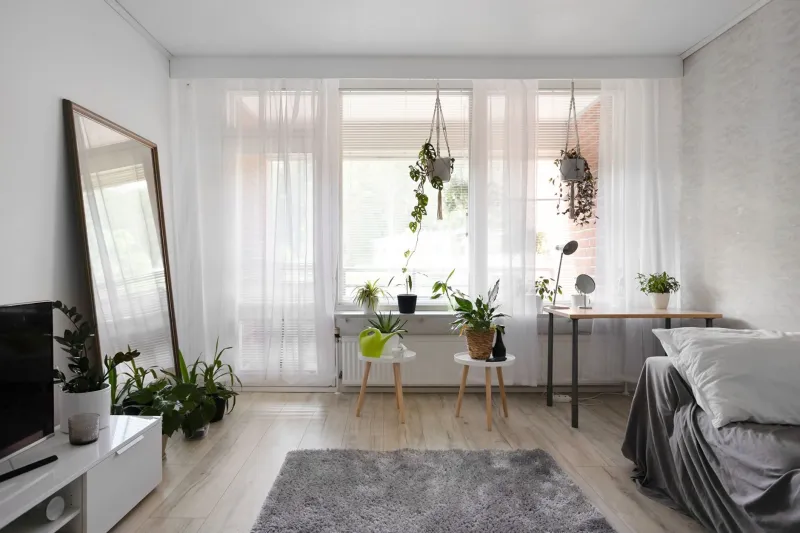
There's a spot in a lot of apartments that doesn't quite know what it is. Too small to be a room. Too defined to be ignored. Maybe it's the angled wall beside the bathroom that creates a triangular pocket nobody planned. Maybe it's the alcove off the kitchen that was probably meant for a phone booth in 1962 and has been collecting mail ever since. Maybe it's the weird recessed shelf situation under your stairs that your landlord described as "bonus storage" with the energy of someone hoping you wouldn't ask follow-up questions.
For a long time, these spaces were embarrassing footnotes in an apartment's story. Now, they're the whole point.
Creative people across the country are not just tolerating these dead zones — they're hunting for them. Deliberately. And what they're doing inside them is quietly reshaping how we think about productive space.
The Case Against the Perfect Room
Here's something nobody tells you when you're scrolling Zillow at midnight: a perfectly proportioned room is kind of a creative nightmare. It gives you nothing to react to. No edge to push against. No limitation to solve your way out of.
Designers have known this for decades, but it's taken a certain kind of apartment dweller — the kind who moves into a place and immediately starts problem-solving instead of apologizing — to make it a lifestyle.
Marcus, a Brooklyn-based illustrator who asked us to use only his first name, has lived in the same Bushwick apartment for six years. The unit's most talked-about feature, at least among his friends, is the narrow alcove off his bedroom that measures exactly four feet wide and seven feet deep. "My realtor called it a 'flex space,'" he says, laughing. "I think she meant it could flex into a closet if you were desperate enough."
Marcus built a desk that runs the full depth of the alcove, mounted his monitor flush to the back wall, and installed a curtain rod at the entrance. When the curtain's drawn, the space essentially disappears from the rest of the apartment. When it's open, it signals to anyone who visits that something real happens there.
"It's not a home office. It's not a studio," he says. "It's more like a thinking booth. I go in there and the rest of the world just... compresses away."
Why Small and Weird Beats Big and Bland
Environmental design research has been circling this idea for years without quite landing on it. What Marcus and creators like him are experiencing has a functional explanation: enclosure creates focus.
When your field of vision is naturally limited — when the walls are close and the ceiling is low and there's simply less world to look at — your brain stops scanning for threats and distractions and starts going inward. It's the same reason people do their best thinking in the shower, or why writers have historically fetishized small, cluttered studies over grand open studios.
The alcove, the angled nook, the under-stair cranny — these spaces enforce a kind of accidental Zen. You didn't choose to limit yourself. The architecture did it for you.
Sophia, a novelist living in a pre-war apartment in Chicago's Logan Square neighborhood, discovered this accidentally when her apartment's oddest feature — a recessed bay with a slanted ceiling that drops to about five feet at its lowest point — became the only place she could actually finish a chapter.
"I tried writing at the dining table, at a proper desk in the bedroom, at coffee shops," she says. "Nothing stuck. Then one afternoon I dragged a chair into that bay just to get out of my own way, and I wrote for four hours straight. Something about not being able to stand up fully made sitting down feel like a commitment."
She's since built the space out with custom cushions, a clip-on reading light, and a small shelf that holds exactly the books relevant to whatever she's working on. Nothing else fits. That's the point.
The Hunt for the Imperfect Apartment
What's genuinely new here isn't that creative people are making do with weird spaces — that's always been true. What's new is that they're starting to seek the weirdness out.
Anecdotally, there's a growing contingent of renters and buyers who will specifically ask about architectural quirks during apartment tours. Not as a red flag, but as a feature. A deep closet with a window. A kitchen bump-out that doesn't make geometric sense. A hallway that widens inexplicably before narrowing again.
Jamie, an independent ceramicist in Portland, Oregon, turned down two larger apartments before landing on a one-bedroom with a low-ceilinged under-stair space that the previous tenant had used as a wine cellar. "The other places were fine. Good natural light, good layout," Jamie says. "But there was nothing to work with. Nothing that needed me to figure it out."
The under-stair space is now a glazing station. The ceiling is too low to stand in, but that's irrelevant — glazing is done sitting or crouching anyway. The enclosed walls mean dust and particulate stay contained. The awkward shape, which the building's original designer probably never once thought about, turns out to be almost exactly right for the task.
"The apartment taught me something about my process," Jamie says. "I didn't know I needed a low, enclosed space to focus until the space showed me."
Designing Into the Weird
If you've got one of these spots and you've been ignoring it, here's the reframe: stop thinking about what the space is supposed to be and start thinking about what it already wants to do.
An alcove that faces away from your main windows is naturally dim and private — that's a reading nook, a meditation corner, or a focused writing spot, not a failed home office. An angled wall that cuts into your floor plan is an invitation to build a custom desk or shelving system that no IKEA hack can replicate. A low-ceilinged nook is a sensory enclosure, a place where the world shrinks to a manageable size.
The materials matter too. Because these spaces are small, you can afford to go a little bolder — a deeply saturated paint color that would overwhelm a full room reads as intentional and immersive in a four-foot alcove. A single great light fixture, a few meaningful objects, a surface that's exactly the right height for what you do there.
You're not decorating a dead zone. You're commissioning the most personal room in your apartment — one that happens to be the size of a generous coat closet.
The Nook as a Philosophy
There's something worth sitting with in all of this. We live in a culture that defaults to bigger, more open, more flexible — open-plan everything, multifunctional furniture, spaces that can be anything and therefore sometimes feel like nothing.
The awkward alcove is a quiet argument against all of that. It says: here is a place for one thing. Here is a place for you.
The creators who've claimed these spaces aren't just being resourceful. They're making a statement about what focus looks like, what privacy means in a world of constant ambient noise, and what happens when you stop waiting for the perfect conditions and start working with the imperfect ones you already have.
Your apartment's worst spot might be the most honest room in it. The question is whether you're ready to move in.