No Corner Left Behind: The Design Revolution Turning Your Apartment's Worst Spots Into Its Best
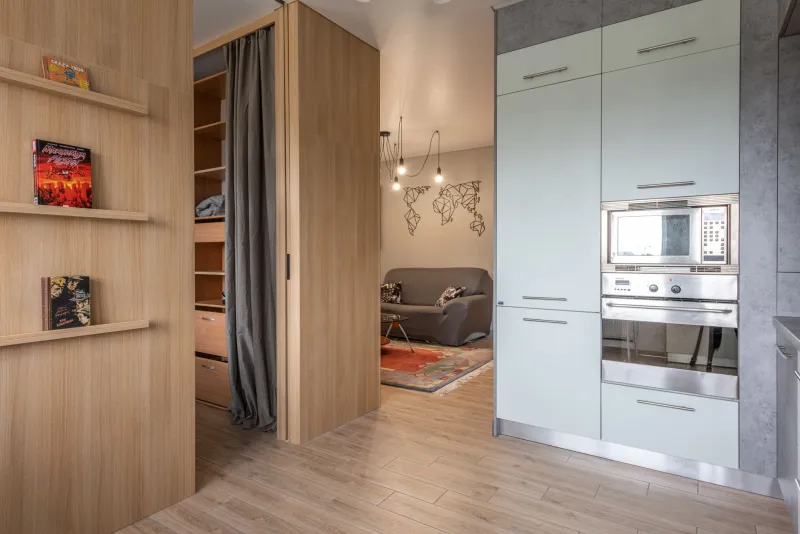
Let's be honest. Every apartment tour has a moment where the leasing agent waves vaguely at a strange triangular corner near the hallway and says something like, "You could put a plant there." And you nod, because what else do you say? But that corner has been quietly haunting you ever since move-in day.
Here at Apartment Number 9, we believe those odd spaces are the whole point. The crooked, the cramped, the architecturally confused — these are the places where genuinely interesting living happens. And increasingly, interior designers agree.
The Problem With "Just Put a Plant There"
For decades, the design industry's unofficial answer to awkward apartment geometry was strategic neglect. Shove a floor lamp in the corner. Stack some books. Maybe hang a tapestry and call it bohemian. But a growing wave of designers — particularly those working with urban apartments in cities like New York, Chicago, and LA — are pushing back against the idea that dead space is just a fact of apartment life.
"Every space has a logic to it, even when it looks completely illogical," says Brooklyn-based interior designer Marisol Vega, who specializes in small-footprint apartments in New York City. "When I walk into a weird corner or a room with a dropped ceiling, I'm not seeing a problem. I'm seeing a prompt."
Vega recently transformed a 340-square-foot studio in Bushwick that featured a bizarre angled wall left over from an old building conversion. Rather than camouflaging it, she built a custom banquette directly into the angle, upholstered in deep olive velvet, with hidden storage underneath. The corner went from being the apartment's most awkward feature to its undisputed centerpiece. Her client now hosts dinner parties there regularly. "People always ask about that corner first," Vega says, laughing.
Sloped Ceilings: Stop Fighting Them
Few architectural quirks cause more renter anxiety than the sloped ceiling — especially in converted attic units or older walk-up buildings where the roofline dips dramatically into the living space. The instinct is to fight it: push furniture away from the low side, hang curtains to distract the eye, try to make the room feel "normal."
Designer and spatial consultant Theo Marchetti, based in Chicago, thinks that instinct is exactly backwards.
"A sloped ceiling is basically free architecture," he says. "It gives a room drama, texture, directionality. If you lean into it instead of apologizing for it, you end up with something that feels intentional and honestly kind of cinematic."
Marchetti's go-to move for sloped ceilings in bedrooms is to position the bed directly under the lowest point of the slope, so the ceiling descends over the headboard like a canopy. Add sconce lighting at the low end rather than overhead fixtures, and the room suddenly feels intimate rather than cramped. "It's a mindset shift," he says. "You're not sleeping in a low-ceilinged room. You're sleeping in a room with a built-in architectural embrace."
For living areas, he often recommends built-in shelving that follows the slope's angle, creating a cascading bookshelf effect that draws the eye upward and makes the whole ceiling feel like a design choice rather than a structural accident.
The Nook Whisperers
Then there are the nooks — those spaces that are too small to be rooms and too defined to be ignored. Coat closets that lost their doors. Recessed alcoves between load-bearing walls. The inexplicable three-foot-deep indent next to the kitchen that no one can explain.
San Francisco designer and longtime Apartment Number 9 favorite Priya Sundaram has made nook transformation something of a personal obsession. Her Instagram feed is essentially a gallery of before-and-afters where spaces that once collected dust bunnies have become reading corners, home offices, mini bars, and meditation nooks.
"The first thing I ask is: what does this person actually need that they don't have room for?" Sundaram explains. "Most apartment dwellers are missing a quiet spot to focus, or a place to display things they love, or just somewhere that feels like theirs. A nook, done right, can be all of that."
One of her most-shared projects involved a narrow alcove in a San Francisco Victorian — barely four feet wide, with an arched opening that made it feel like a decorative afterthought. Sundaram installed a built-in desk at the perfect ergonomic height, ran floating shelves up both side walls, and painted the entire interior a saturated deep teal that contrasted sharply with the white walls outside it. The effect is like looking into a jewel box. Her client, a freelance writer, now refers to it as "the only place I can actually think."
DIY Moves for Real Renters
Not everyone has the budget for a designer or the landlord approval for built-ins. But there are genuinely effective ways to reclaim awkward spaces without a renovation.
Go vertical in corners. A tall, narrow ladder shelf placed diagonally in a corner takes up minimal floor space while creating visual height and storage. Look for styles with irregular spacing between rungs — they feel more artistic than utilitarian.
Use paint to define, not hide. Painting an odd nook or alcove in a contrasting color instantly frames it as intentional. This works especially well in rentals because it's reversible. A deep charcoal or forest green can make a weird indented wall feel like a curated display space.
Embrace the low zone. If a sloped ceiling makes part of a room too low for standing furniture, go floor-level. Oversized cushions, a low platform bed frame, a Japanese-style floor seating arrangement — all of these work beautifully under a slope and make the whole space feel considered rather than compromised.
Let the corner do the heavy lifting. Corner-specific furniture — rounded sectionals, corner desks with curved edges, triangular shelving units — exists precisely for this problem and tends to be underused. A well-chosen corner piece can anchor an entire room's layout.
The Bigger Shift
What all of these designers have in common is a fundamental reframe: they've stopped treating architectural quirks as obstacles and started treating them as collaborators. The apartment isn't fighting you. It's just waiting for someone to figure out what it's actually good at.
That's the whole ethos here at Apartment Number 9 — the weird spots, the tight corners, the rooms that don't make immediate sense are exactly where the most interesting living happens. Your apartment's strangest feature might just be its best one. You just haven't introduced yourself yet.