Walls That Close In, Worlds That Open Up: How Tiny Apartments Are Fueling Big Creative Work
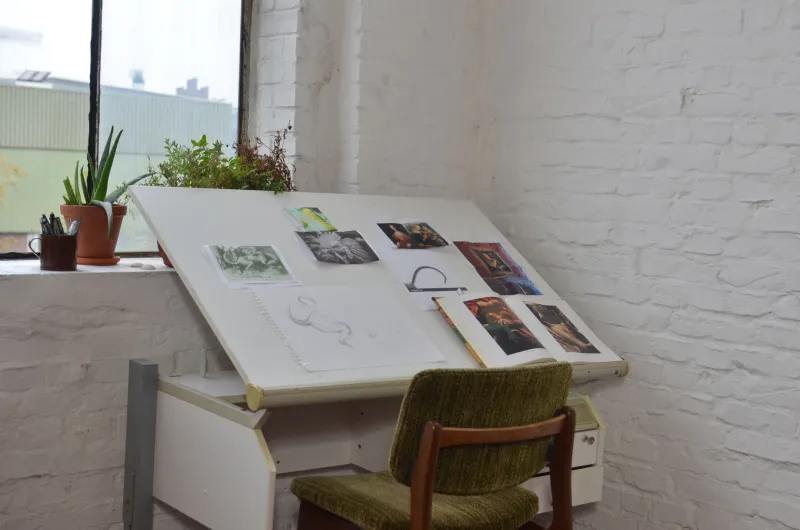
Somewhere in a 280-square-foot apartment in Astoria, Queens, a musician is making an album that sounds like it was recorded in a cathedral. The reverb is fake. The space is not. What's real is the desk wedged against the radiator, the guitar hanging on the wall because there's nowhere else to put it, and the foam panels covering the single window that serve double duty as soundproofing and blackout curtain. It's not glamorous. It's also, by every measure that matters, working.
This is the part of the creative life that doesn't make it onto mood boards: the actual square footage where the work gets made. And if you spend any time talking to working artists, musicians, and writers — especially those grinding it out in expensive American cities — a pattern emerges that feels almost counterintuitive. The smaller the space, the bigger the output. The tighter the walls, the wider the imagination seems to stretch.
The Constraint Paradox
Creativity researchers have been circling this idea for years. Studies out of institutions like Cornell and the University of Utah have found that physical constraints — limited space, restricted resources, even low ceilings — can actually push the brain toward more unconventional thinking. When you can't spread out, you go deeper. When there's no room to pace, you sit with the discomfort long enough for something interesting to happen.
But you don't need a research paper to prove what artists have been living for generations. You just need to look at the work.
Jamie Okonkwo, a painter based in a 350-square-foot apartment in Logan Square, Chicago, spent the first two years after moving there frustrated by the fact that he couldn't fit a canvas larger than 24 by 36 inches in his space without knocking something over. So he stopped fighting it. He went small — miniature oil paintings, some no bigger than a playing card, rendered in obsessive detail. That body of work got him his first gallery show. "I never would have developed that precision if I'd had room to be sloppy," he says. "The apartment basically taught me a new skill."
That's the constraint paradox in action. The limitation didn't shrink his practice. It focused it.
The Micro-Apartment as Creative Incubator
For writer and essayist Dana Reyes, her 400-square-foot studio in Silver Lake, Los Angeles, functions less like a home and more like what she calls "a pressure cooker for ideas." Everything is within arm's reach. Her writing desk is two feet from her bed. Her bookshelves cover every available wall surface. There's no separation between living and thinking because there's no physical room for separation.
"In a bigger apartment, I used to wander," she says. "I'd go to the kitchen, then the living room, then the bedroom. I was always moving away from the work. Now there's nowhere to escape to. The work is just... there. Waiting. And eventually you stop running from it."
This is a theme that comes up again and again in conversations with creatives in small spaces: the accidental productivity of having nowhere to hide. The apartment becomes a container not just for your stuff but for your attention.
For musician and producer Sasha Tran, who records electronic music in a converted one-bedroom in Crown Heights, Brooklyn, the smallness of the space has shaped the actual sound of her music. "Everything I make has this kind of intimacy to it," she explains. "I think it's because I'm literally inches from my equipment. There's no distance between me and the sound. It gets into the work."
Her last EP, recorded almost entirely in that apartment, earned comparisons to artists with full studio access and significantly larger budgets. The constraint, she argues, created a signature.
Designing a Tiny Space That Works Hard
Of course, a small apartment doesn't automatically become a creative sanctuary just by being small. Chaos is also possible. Clutter is definitely possible. The difference between a micro-apartment that fuels your work and one that just stresses you out often comes down to a few intentional design choices.
Protect your one sacred surface. Every creative in a small space needs at least one surface that is exclusively for making things — not for mail, not for coffee cups, not for the stuff that accumulates by default. It doesn't have to be big. A 24-inch wall-mounted desk folds up when not in use and still counts. The ritual of sitting down at a dedicated space signals to your brain that it's time to work.
Let your tools be the decor. In a small apartment, hiding your creative equipment in cabinets and closets means you're less likely to use it. Hang the guitar on the wall. Put the paints on open shelving. Keep the sketchbook on the coffee table. When your tools are visible, they're in conversation with you even when you're not actively using them. Ideas happen in the in-between moments.
Curate aggressively. The small-space creatives who thrive tend to be ruthless about what they allow into their environment. Every object either serves a function or genuinely inspires something. Dead weight — the stuff you keep out of obligation or inertia — takes up not just physical space but mental bandwidth. Treat your apartment like a gallery. Only hang what you'd actually want to look at every day.
Build in one deliberate sensory anchor. A candle you only burn when you're working. A specific playlist that only plays during creative hours. A particular lamp that you switch on when it's time to make something. Small spaces benefit enormously from these kinds of ritualized signals because there's so little physical transition between "life mode" and "work mode." You have to manufacture the transition yourself.
The Apartment as Collaborator
There's something almost philosophical happening here, and it feels worth saying out loud: the artists who seem to thrive in small spaces are the ones who've stopped thinking of their apartment as a limitation and started thinking of it as a participant in the work.
Jamie, the painter in Chicago, talks about his apartment "pushing back" against certain ideas and forcing him toward better ones. Dana, the essayist in Silver Lake, describes her studio as "the co-author I never asked for." Sasha, recording in Brooklyn, says the apartment is "in the mix" of every track she makes, sonically and spiritually.
This is exactly the kind of living that Apartment Number 9 was built around — the idea that odd spaces don't just house extraordinary lives, they help create them. Your 350 square feet aren't a compromise. They're a collaborator. A pressure chamber. A constraint with opinions.
The walls aren't closing in. They're leaning in. There's a difference, and it's everything.