The Space Talks Back: How Your Apartment Has Been Quietly Rewriting Who You Are
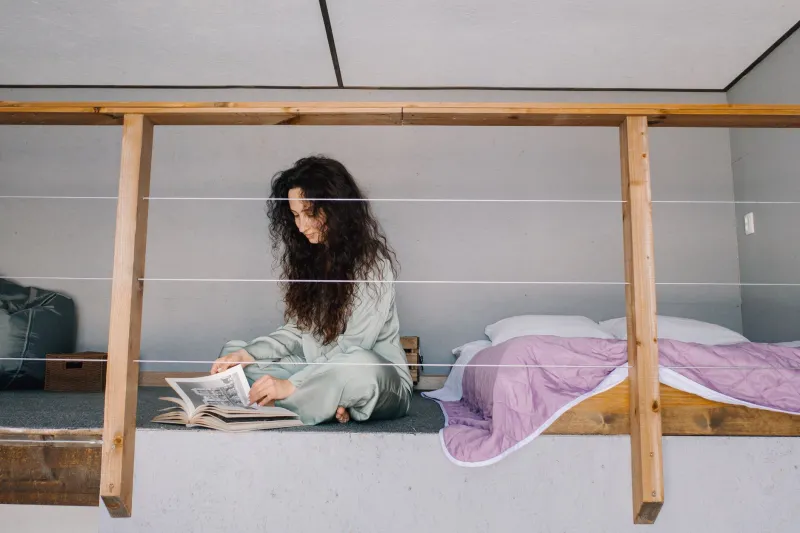
Nadia didn't set out to become a morning person. For most of her twenties, she was a committed night owl — working late, sleeping in, running on the kind of schedule that makes brunch reservations feel genuinely aggressive. Then she moved into a place in East Nashville with east-facing windows that offered no curtains and no mercy.
"The light just comes in," she says, with an expression somewhere between acceptance and defeat. "Like, completely. There's nothing you can do. So now I wake up at six, I make coffee, I sit with it. And honestly? I think it changed my whole relationship with mornings."
The apartment didn't ask her permission. It just rearranged her.
Your Space Has an Agenda
This is the part of the home conversation that design magazines tend to skip: your apartment isn't a passive container for your life. It's an active participant. The dimensions of your rooms, the placement of your windows, the specific obstacles and affordances your layout presents — all of it is quietly shaping the way you move through the world.
Environmental psychologists call this affordance theory — the idea that spaces don't just reflect our behavior, they invite and constrain it. A narrow apartment with one central hallway makes you more likely to move in a linear, sequential way — room to room, task to task. A wide-open loft encourages diffuse attention, creative wandering, the kind of thinking that doesn't follow a straight line.
Neither is better. But both are doing something to you that you probably haven't fully accounted for.
The Constraint That Became a Superpower
Marcus lives in a studio in Chicago's Logan Square that is, by any objective measure, too small for his ambitions. He's a ceramicist who works from home, which means his living space, sleeping space, and creative space are in a constant, ongoing negotiation with each other.
"At first it felt like a limitation," he says. "Like, I had to pack up my work every night to have a functional bedroom. I resented it."
But something shifted. The nightly packing ritual became a forcing function — a daily practice of completing work rather than leaving it in a permanent state of almost-done. "I can't just leave a project out indefinitely. Every day has a natural end point. And it turns out that's exactly the discipline I needed."
The constraint didn't just change how he worked. It changed what he made. Smaller, more contained pieces. Works that could be completed in a single session. A body of work that, he admits, never would have existed in a bigger space.
"My apartment basically art-directed my whole practice," he says. "Without consulting me."
The Personality Adjustment You Didn't See Coming
It's not just creative types who experience this. The research on person-environment fit — a concept borrowed from organizational psychology and applied increasingly to residential spaces — suggests that the degree of alignment between your personality and your space has measurable effects on your psychological wellbeing, your sense of identity, and even your social behavior.
Simply put: when your apartment fits, you feel more like yourself. When it doesn't, you adapt — and sometimes those adaptations become permanent.
People who move from loud, open-plan apartments to quieter, compartmentalized spaces often report becoming more introspective, more deliberate in their social choices. The reverse is equally true: someone who spent years in an isolated studio and then moved to a building with shared common spaces frequently describes becoming, almost against their will, more communal.
The space rewrites the person. The person then finds new spaces that match the rewrite. It's a feedback loop that operates mostly below the level of conscious decision-making.
The Rooms We Don't Talk About
There's a particular category of spatial influence that almost nobody acknowledges: the effect of the rooms we don't use.
A spare bedroom that's become a storage room. A dining area that's slowly been colonized by work equipment. A living room that nobody actually lives in because the couch faces the wrong way and the light is weird and somehow you always end up in the kitchen.
These non-functioning spaces carry a psychological weight that's disproportionate to their square footage. They represent something — an aspiration, a failure, an unresolved question about how you want to live. And their presence shapes the energy of the whole apartment in ways that are hard to articulate but easy to feel.
Jamila, who lives in a two-bedroom in Atlanta, spent two years using her second bedroom as a dumping ground before she finally cleared it out and set it up as a dedicated reading room. "The apartment felt different immediately," she says. "Like, the whole energy shifted. I don't know how to explain it except that it felt like I'd made a decision about myself."
The room wasn't just a room. It was a question she'd been avoiding. Answering it changed something.
What Your Apartment Is Trying to Tell You
If you sit with this long enough, a useful question emerges: what is your current space inviting you to become?
Not what you wish it invited. Not what it invited five years ago when you moved in under different circumstances. Right now, with the layout as it is, the light as it falls, the constraints and the strange little gifts it offers — what version of you does this apartment seem to be rooting for?
Maybe it's a version that wakes up early because the windows demand it. Maybe it's a version that makes smaller, more intentional things because the square footage leaves no room for sprawl. Maybe it's a version that's more social, or more solitary, or more patient, or more adaptable.
The apartment has been working on you this whole time. The interesting question isn't whether you've been shaped by it — you have, you absolutely have — but whether you've been paying attention to the shape.
The Collaboration You Never Agreed To
Nadia still wakes up at six. She's not sure she'd go back to the night owl life even if she could. "The light kind of forced a version of me that I actually like," she says, laughing a little. "Which is a weird thing to say about an apartment."
It's not weird. It's exactly right.
The best spaces don't just accommodate who you already are. They pressure you, gently and persistently, toward who you might become. They create conditions for growth that you wouldn't have chosen consciously but that turn out, in retrospect, to be exactly what you needed.
Your apartment has been doing this work the whole time you've been living in it. The creaky floor that made you more careful. The tiny kitchen that made you more resourceful. The weird nook that made you more still.
You didn't just live there. You were made there.
And wherever you go next, you'll carry the shape of it with you.