You Live With It, But Does It Live With You? The Strange Intimacy of Your Apartment's Imperfections
Somewhere around month three in her Brooklyn one-bedroom, Dani Reyes stopped being annoyed by the kitchen faucet that drips exactly twice every forty-five seconds. She started listening for it. And then, without fully realizing it, she started timing her mornings around it—coffee poured at the first drip, laptop open by the second. "It sounds insane," she admits, "but it felt like the apartment was keeping pace with me."
It doesn't sound insane at all. It sounds like intimacy.
We talk a lot about the apartments we want—open floor plans, natural light, that mythological second closet—but we spend surprisingly little time acknowledging what happens when we actually live inside imperfect ones. Which is to say: all of them. Because somewhere between the first lease signing and the last box unpacked, something shifts. The quirks stop being problems. They become personalities. And your apartment, that inanimate collection of drywall and radiator pipes and stuck windows, starts to feel like it has a point of view.
The Psychology of Personifying Your Space
Psychologists have a term for the tendency to assign human characteristics to non-human things: anthropomorphism. We do it with cars, houseplants, Roombas. Apartments are no different—except that apartments are also where we sleep, cry, eat cereal at midnight, and do all the other things we'd never do in front of actual people. The vulnerability we bring to a home creates the conditions for a relationship.
Dr. Ariel Lev, a behavioral researcher who studies environmental psychology, explains it this way: "When a space is imperfect, it demands your attention and adaptation. You're constantly in a low-level negotiation with it. That negotiation, over time, starts to feel reciprocal—even when, logically, you know it isn't."
The negotiation is the relationship. The stuck window you've learned to coax open with exactly the right amount of upward pressure isn't just a maintenance issue. It's a secret handshake. The electrical outlet inexplicably placed at knee level behind the bookshelf? You've rerouted your entire living room around it. You've accommodated it. You've compromised.
That's not dysfunction. That's cohabitation.
The 3 AM Radiator Problem (Which Is Not Actually a Problem)
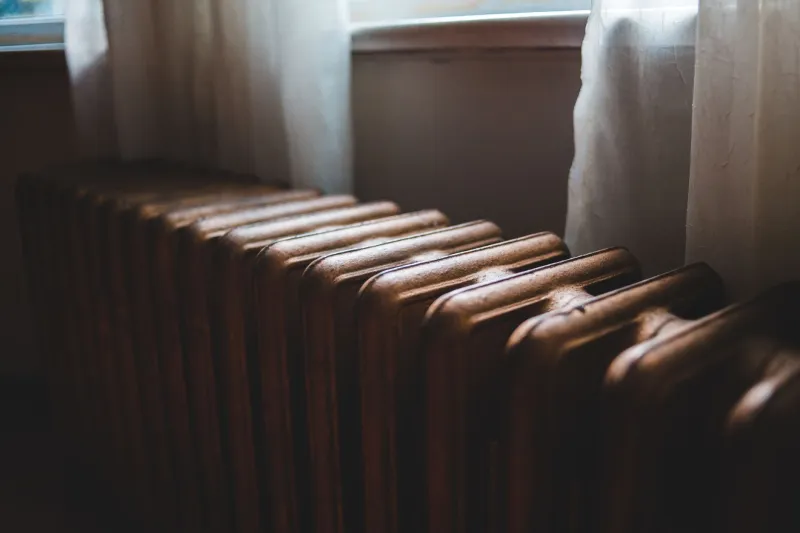
Ask any New Yorker, Chicagoan, or Bostonian who's lived in a pre-war building about their radiator and watch their face do something complicated. There's irritation in there, sure. But there's also something that looks a lot like affection.
The clank-and-hiss of steam heat is one of America's most divisive apartment sounds. It is also, for millions of renters, the sound of home. Not home as an abstract concept—but their specific home, in their specific apartment, on their specific block. The radiator that starts up at 6:47 every morning becomes an alarm clock. The one that bangs twice and then goes quiet becomes a punctuation mark at the end of the day.
Marcus Webb, a musician living in a converted apartment building in Philadelphia, has recorded his radiator every winter for four years. "It's not the same twice," he says. "The rhythm changes depending on how cold it is outside. I started thinking of it as this ongoing improvisation—the building responding to the weather. It's the most honest thing in my apartment."
That word—honest—comes up a lot when people talk about their apartments' imperfections. There's something about a quirk that can't be faked. A perfectly staged space tells you nothing about itself. A door that swings slightly left unless you pull it slightly right tells you everything: this building is old, it has settled, it has history, and now it has you.
Character Traits, Not Defects
The language we use matters. Calling something a "defect" places it in a category of things to be fixed, replaced, or apologized for. Calling it a "character trait" places it in a category of things to be understood, worked with, and eventually appreciated.
Renters who stay in apartments for years—rather than perpetually chasing the next, better place—tend to make this linguistic shift naturally. The ceiling that's an inch lower on one side becomes "the slanted wall where I do my best thinking." The bathroom light that flickers for thirty seconds before it commits becomes a ritual, a small ceremony of waiting that somehow makes the morning feel intentional.
Interior designer and apartment-dweller Sonya Prakash, who has lived in the same Chicago two-flat for eleven years, puts it plainly: "I've had the chance to move into nicer places. More modern, more logical. But this apartment knows my schedule. It sounds like me now. Starting over somewhere new feels like starting a conversation from scratch."
When the Space Shapes the Person
Here's where it gets genuinely interesting: the relationship isn't just emotional. It's behavioral. The odd outlet shapes where the desk goes. The desk shapes where the chair goes. The chair, positioned next to the window that only opens halfway, becomes the reading spot. The reading spot becomes the place where ideas happen. The ideas that happen there start to carry the texture of that particular light, that particular draft, that particular view of the neighbor's fire escape.
Your apartment's imperfections are not obstacles to your creative life. In many cases, they are the architecture of it.
This is the thing that perfectly optimized spaces can't offer: constraint that generates character. When everything is adjustable, nothing is defining. When the window sticks, you learn what you look at when you can't open it all the way. That's not a limitation. That's a conversation.
Making Peace With Your Accidental Roommate
If you've been fighting your apartment's quirks, consider a different approach: curiosity. Not the kind that leads to a maintenance request (though, yes, fix the things that need fixing). The kind that asks what this particular imperfection is doing to your daily life, your mood, your routine.
Keep a loose mental log for a week. Notice what the drip sounds like at 11 PM versus 7 AM. Pay attention to what you do when the heat kicks on unexpectedly. Track whether you feel differently in the room with the low ceiling versus the one with the too-tall windows. You might be surprised by what you find.
Dani Reyes, back in Brooklyn, recently renewed her lease for the third time. The faucet still drips. She still times her mornings around it. "I thought about getting it fixed once," she says. "And then I thought—why would I do that? It's the only roommate I've ever had who never complains about the dishes."
Fair enough.