One Apartment, Many Worlds: Meet the Artists Who've Turned Their Square Footage Into a Creative Multiverse
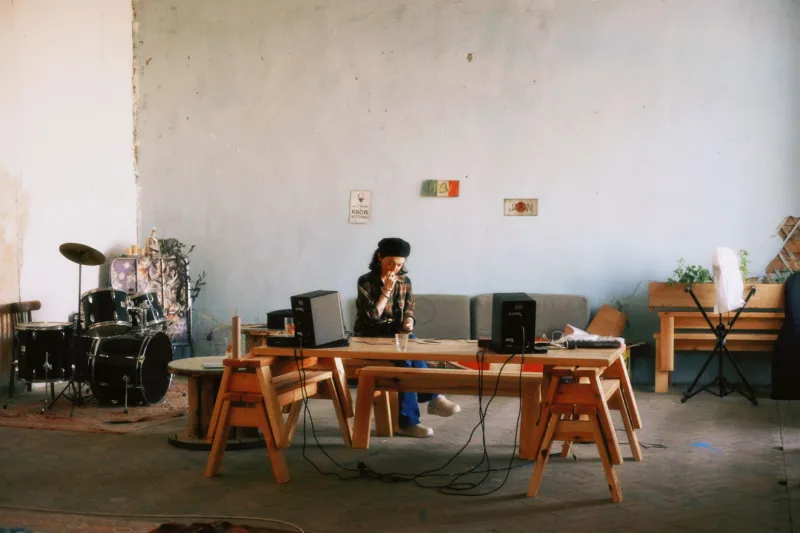
Daniela Reyes makes music in her closet. Not metaphorically — literally, physically, in a closet in her one-bedroom apartment in East Nashville, where she's hung acoustic foam panels over her winter coats and set up a compact audio interface on a shelf she built herself from a $40 kit. When she steps in and pulls the door mostly shut behind her, the outside world — the street noise, the neighbor's TV, the ambient hum of a city — disappears. "It took me a while to stop feeling embarrassed about it," she says. "Now I think it's the best studio I've ever worked in."
Reyes is not an outlier. Across the country, artists working in small apartments have stopped waiting for the day they can afford a dedicated studio, a proper darkroom, a soundproofed practice room. Instead, they've started building those spaces into the apartments they already have — compartmentalizing their square footage into distinct creative zones, each one purpose-built for a specific kind of work. The results are part ingenuity, part obsession, and entirely fascinating.
The Zone Theory of Small Living
Urban planners have long talked about zoning — the idea that different areas of a city serve different functions, and that those functions shape the activity that happens within them. The artists we spoke to have applied a version of this logic to their apartments, and the effects on their creative output have been striking.
The core insight is deceptively simple: physical environment shapes mental state. When you sit down at the same kitchen table where you eat breakfast and scroll your phone and have awkward video calls with your family, your brain doesn't automatically shift into creative mode. But when you step into a space that exists only for making music, or developing film, or writing — a space that looks different, smells different, feels different — something in your nervous system responds.
"My writing corner is stupid small," admits Marcus Webb, a fiction writer who lives in a studio apartment in Philadelphia. "It's literally just a chair, a tiny desk, and a curtain I hung to block off that section of the room. But when I'm on that side of the curtain, I write. When I'm on the other side, I don't. My brain has just... accepted this deal."
Webb's curtain solution cost him about thirty dollars. The productivity shift, he estimates, has been enormous.
The Darkroom in the Bathroom
For film photographers, the challenge of small-apartment creative living has a specific, chemical dimension. Traditional darkrooms require running water, complete darkness, and enough space to work with enlargers and developing trays. None of that sounds like something you can fit into 700 square feet.
Jasmine Okoro, a documentary photographer based in Chicago, has been developing film in her bathroom for three years. She's refined the process to something that takes about forty-five minutes to set up and fifteen to break down. The door seal is a towel and a blackout curtain she installed on a tension rod. The developing chemicals live in a cabinet under the sink. Her enlarger, the most space-intensive piece of equipment, folds flat and slides between her dresser and the wall.
"People always ask me when I'm going to get a real darkroom," she says. "And I always think: this IS a real darkroom. I've made real photographs in this bathroom. The photographs don't know it's a bathroom."
There's something philosophically interesting in that framing. The legitimacy of a creative space isn't determined by its square footage or its purpose-built design. It's determined by the work that comes out of it.
Building the Zones: What Actually Works
Across the artists we talked to, a few consistent principles emerged about what makes small-apartment creative zones actually function.
Sensory differentiation matters more than size. The zone doesn't need to be large — it needs to feel distinct. Different lighting, a specific scent (several artists mentioned candles or incense they burn only in their creative space), a particular texture underfoot. Your brain is remarkably good at taking cues from its environment; the more consistent those cues are, the faster you can shift into the mental state you need.
Friction is the enemy. If setting up your creative space takes more than a few minutes, you will find reasons not to do it. Every artist we spoke to had iterated toward lower and lower setup times. The photography equipment that used to take an hour to assemble now takes ten minutes. The recording setup that required moving furniture now lives permanently in the closet. "Make it stupid easy to start," Reyes says. "Because the moment it becomes a project to even begin, you won't begin."
Containment is a feature, not a bug. This was perhaps the most counterintuitive insight. Several artists described how the physical smallness of their creative zones had actually sharpened their focus. Webb's tiny writing corner means he can only have the things he needs to write — there's no room for anything else. Okoro's bathroom darkroom means she works efficiently because she has to. "Constraints force decisions," she says. "And decisions are where creative work actually happens."
The Psychological Architecture of Creative Space
There's a growing body of research supporting what these artists have figured out through trial and error. Environmental psychology has long documented the way physical spaces shape cognitive states — a phenomenon sometimes called "context-dependent memory," which describes how our brains associate specific mental states with specific environments.
What the small-apartment artists are doing, essentially, is hacking this mechanism. By creating a consistent physical context for creative work — even a very small one — they're building a reliable on-ramp to the focused state that creative work requires.
This might explain why so many of them resist the idea of moving to a larger space, even when they can afford to. The constraints that initially felt like limitations have become structural to how they work. The closet studio isn't a compromise — it's the system.
Starting Your Own Creative Laboratory
If you're a creative person living in a small apartment and you've been waiting for more space before you get serious about your practice, the artists we spoke to have some collective advice.
Start with the smallest possible intervention. You don't need to overhaul your apartment — you need one corner, one shelf, one curtain. Identify the creative practice you most want to support and ask what the absolute minimum viable space for that practice looks like. Then build that.
Be specific about what goes in the zone and what doesn't. The power of these spaces comes from their dedicated purpose. A music production closet that also stores your off-season clothing and your suitcases is just a closet. A music production closet that contains only music production equipment is a studio.
Give it a name. This sounds silly until you try it. Reyes calls her closet "the booth." Webb calls his corner "the office." Okoro calls her bathroom setup "the lab." Naming a space grants it a kind of legitimacy that changes how you inhabit it.
And then — and this is the part nobody wants to hear — use it. Show up in the zone when you said you would. The space can't do the work for you. But it can, if you let it, make the work feel possible in a way it didn't before.
Your apartment is already full of potential creative laboratories. You just haven't named them yet.