Neither One Thing Nor Another: The Quietly Radical Life of the Uncategorizable Apartment
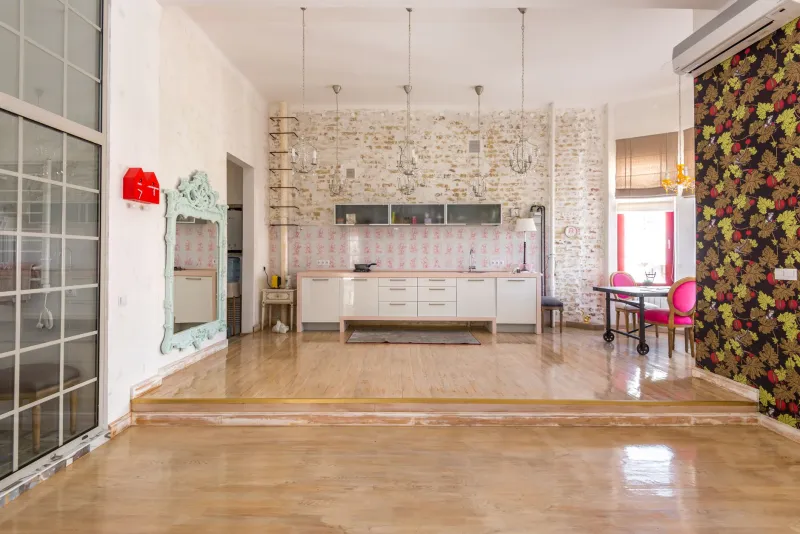
You know the listing. It says "studio" but there's a half-wall that almost makes a bedroom. It says "industrial" but there are crown moldings that clearly didn't get the memo. The floor plan looks like someone started drawing a one-bedroom, got distracted, and just kind of went with it. You move in expecting to figure it out. Six months later, you're still figuring it out — and somehow, weirdly, that's the best thing that ever happened to your interior life.
The uncategorizable apartment is more common than you'd think, especially in older American cities where buildings have been chopped up, added onto, converted, and reimagined across decades. Chicago walk-ups with inexplicable sunrooms. Brooklyn railroad apartments with a mystery room that's too small to be a bedroom and too large to be a closet. San Francisco flats where the kitchen is technically in the hallway and everyone has just agreed not to talk about it. These spaces exist in the margins of real estate language, and the people who end up in them — by accident or by choice — tend to have a lot to say.
The Tyranny of the Template
Here's the thing about categorizable apartments: they come pre-loaded with expectations. A sleek Scandinavian studio tells you to buy a platform bed, a fiddle-leaf fig, and exactly three decorative objects. A cozy vintage one-bedroom in a brownstone whispers gallery wall, velvet sofa, the collected works of someone who reads a lot. These aren't bad aesthetics. But they are borrowed ones. When the space hands you a template, it's easy to just fill it in.
The apartment that resists category doesn't offer that convenience. It just sits there, architecturally ambiguous, waiting for you to make a decision. That room that's neither living room nor office nor dining room — what do you do with it? The ceiling that's low on one side and cathedral-high on the other — do you fight it or lean into the drama? The windows that face a brick wall but flood the place with reflected light in the late afternoon — is that a flaw or a feature?
These are not rhetorical questions. The uncategorizable apartment demands actual answers, and in demanding them, it does something quietly profound: it makes you figure out what you actually want.
The Liminal Space as Creative Incubator
Designers and architects have a word for spaces that exist between defined categories: liminal. Originally borrowed from anthropology — where it describes the threshold state between one identity and another — it's become useful shorthand for any space that refuses to commit. And liminality, it turns out, is generative.
When you're not constrained by what a space is supposed to be, you're free to experiment in ways that categorizable apartments quietly forbid. That half-wall becomes a library. The weird alcove becomes a reading nook so specific to your body and your habits that no interior design magazine could have predicted it. The kitchen-adjacent mystery room becomes a fermentation station, a darkroom, a place where you do the weird hobby you've never had room for before.
Residents of these spaces often describe a particular kind of creative momentum that builds over time. Because the apartment never settles into a final form, neither do they. There's always another iteration to try, another arrangement that might unlock something. The space stays alive in a way that finished, perfectly decorated apartments sometimes don't.
Learning to Stop Explaining It
There's a social awkward phase that comes with living in an uncategorizable apartment. People visit and ask questions you can't quite answer. Is this the living room? Sort of. Do you have a bedroom? Kind of — it's more of a sleeping alcove that also has my desk in it. What's that room? I'm still deciding.
For a while, this feels like a failure. Like you haven't figured it out yet. Like the apartment is a problem you haven't solved.
But at some point — and residents of these spaces often describe this as a genuine turning point — you stop trying to explain it in terms that other people already understand. You stop reaching for the vocabulary of conventional floor plans and start describing what the space actually does for you. That room isn't a home office or a guest room; it's where I go when I need to think. The living area isn't a living room in the traditional sense; it's a space that reconfigures depending on whether I'm alone or hosting or working or just existing.
This shift — from categorizing to describing, from conforming to articulating — is where the apartment starts to become genuinely yours.
The Aesthetic That Only You Could Have Made
One of the most interesting things about people who've lived long-term in uncategorizable apartments is that their spaces tend to look like them in a way that's hard to fake. Because they couldn't borrow a template, they had to develop a point of view. Because the architecture didn't suggest a style, they had to figure out what they actually liked rather than what fit.
The result is often an aesthetic that's impossible to replicate — not because it's expensive or rare, but because it's the product of a specific person navigating a specific set of spatial constraints over a specific period of time. The vintage lamp that ended up in the kitchen because it was the only place it fit, and then became the defining vibe of the whole apartment. The way the furniture got arranged to deal with the weird traffic flow, and accidentally created the most intimate dinner party setup anyone's ever sat in.
These spaces can't be Pinterest-boarded into existence. They have to be lived into.
Embracing the Ongoing Question
If you're currently living in an apartment that won't cooperate with categorization, here's the reframe: the confusion is the point. The space that refuses to tell you what it is has handed you something rare — the obligation to decide for yourself.
You don't have to solve it. You don't have to arrive at a final answer about what the weird room is or what style the apartment belongs to. You just have to keep showing up, keep experimenting, keep letting the space ask you questions you haven't thought to ask yourself.
The apartments that resist every category aren't the ones that got away. They're the ones that stayed interesting. And in a world full of spaces that are optimized, staged, and pre-interpreted for your convenience, a little unresolvable ambiguity might be the most valuable square footage you'll ever inhabit.