Chaos Theory, Decorating Edition: What Happens When Your Apartment Refuses to Pick a Lane
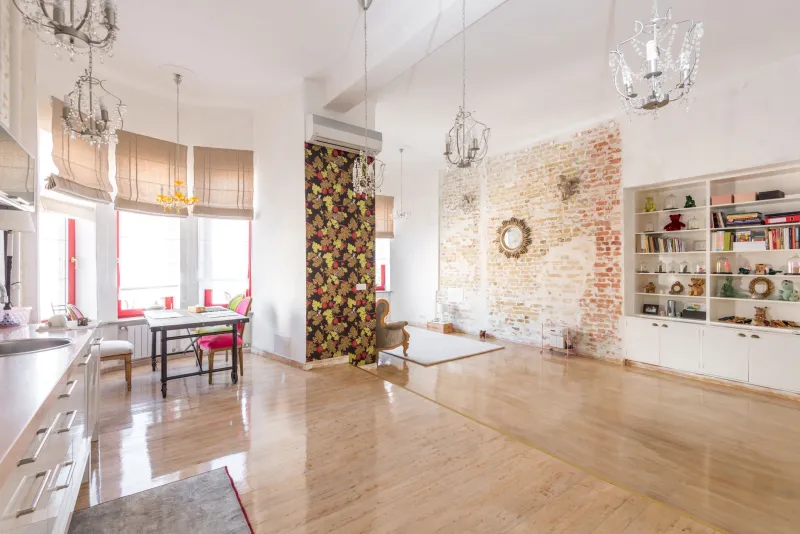
You know the apartment. Maybe you live in it. There's a mid-century credenza sitting beneath a maximalist gallery wall that has absolutely no business being in the same room as a brutalist concrete lamp and a grandma-adjacent floral armchair. There's no throughline. No cohesive palette. The rug is from a flea market in Pasadena, the throw pillows are aggressively Scandinavian, and somehow — somehow — the whole thing works better than any room you've ever seen on Instagram.
This isn't a design accident. It's a design argument.
Pinterest Lied to You (Gently, With Good Intentions)
Let's be honest about what Pinterest actually is: a machine for manufacturing aesthetic anxiety. You start a board called "home inspo" with genuine excitement, and eighteen months later you've pinned 340 images of the exact same linen sofa in the exact same shade of warm greige, arranged in the exact same open-plan living space with the exact same cluster of dried pampas grass in the corner. You haven't found your style. You've found a style. One style. The style that the algorithm decided you deserved.
The pressure to achieve what interior design culture calls a "unified look" is everywhere — in the language of home decor blogs, in the room-reveal content that dominates social feeds, in the way furniture retailers package entire aesthetics as a single purchasable identity. "Coastal grandmother." "Dark academia." "Japandi." These aren't just vibes. They're products. And the implicit message is that if your space doesn't commit to one of them fully, you've somehow failed at living.
But here's the thing nobody in the sponsored content pipeline will tell you: the most creatively alive spaces — the apartments where interesting people do interesting things — almost never have a unified look. They have a unified feeling. And those are completely different things.
The Apartment as Autobiography, Not Catalog
When a space resists aesthetic cohesion, it's usually because the person living in it resists it too. Artists, writers, musicians, designers who are actually producing original work tend to accumulate objects the way they accumulate ideas — impulsively, across categories, following instinct rather than system. The result is an apartment that reads less like a showroom and more like a mind.
Think about the creative people you know whose homes you've genuinely loved spending time in. Chances are you couldn't easily describe the "style." You'd probably reach for something like: warm or layered or interesting or theirs. There's a velvet couch that belonged to someone's aunt. A collection of vintage scientific diagrams framed in mismatched thrift-store frames. A kitchen table that's seen better decades, surrounded by chairs that have clearly never met each other. Nothing matches. Everything belongs.
What these spaces share isn't a design philosophy. It's an absence of one — or more precisely, an active resistance to the idea that a space needs to justify its choices to anyone.
Mismatched Eras Are Actually in Conversation
One of the more underrated things that happens when you stop forcing aesthetic unity is that your objects start talking to each other. Not literally (though if your apartment is anything like some of the ones we write about around here, maybe literally). But a 1970s wicker pendant light hanging over a very serious, very modern desk creates a tension that a perfectly matched setup never could. That tension produces something. It makes you look. It keeps a room from going dead.
Interior designers with genuinely adventurous practices have been saying this for years — that contrast is the engine of visual interest, and that spaces curated too tightly within a single era or aesthetic tend to feel airless. Frozen. Like a diorama of a life rather than a life itself.
When your apartment refuses to have a style, it's often forcing this kind of productive contrast on you whether you intended it or not. The weird proportions of an older building won't cooperate with sleek contemporary furniture, so you compromise, you improvise, you layer — and you end up somewhere more interesting than where you were trying to go.
What the Resistance Is Actually Telling You
There's a version of this conversation that's just about aesthetics, and then there's the version that's about something bigger. Because the compulsion to achieve a unified home look isn't really about design. It's about legibility. About wanting to be read correctly. About the social anxiety of having someone walk into your space and not immediately understand who you are.
A cohesive aesthetic is, in a very real sense, a defensive move. It says: I have this under control. I know what I'm doing. I've made deliberate choices and those choices communicate a coherent identity. Which is fine! Totally valid! But it also forecloses the possibility of being genuinely surprising — to your guests, and maybe more importantly, to yourself.
The apartment that refuses to pick a lane is making a different bet. It's saying: I contain multitudes. I was different last year. I might be different next year. I'm not trying to be a brand.
For people whose creative work depends on staying porous — staying open to unexpected influences, resisting the calcification of a fixed identity — that kind of space isn't chaotic. It's strategic.
How to Stop Fighting Your Apartment's Refusal
If you've been wrestling with a space that won't cooperate with your carefully assembled mood board, here's a genuinely useful reframe: stop treating the resistance as a problem to solve and start treating it as information.
What is the apartment actually doing? Where does it feel most alive — most itself? Usually it's the corner you stopped trying to control, the shelf that accumulated objects without a plan, the wall that got weird because you ran out of time to make it intentional. Those are your data points.
Instead of forcing the rest of the space to conform to a predetermined aesthetic, try following those accidental successes. Lean into the mismatched eras. Let the thrift-store find sit next to the expensive piece. Let the room be in the middle of a sentence rather than a finished statement.
Your Pinterest board will survive the betrayal. Your apartment, freed from the obligation to be coherent, might finally start telling you something true.
The spaces that refuse to be categorized are usually the ones worth spending time in. Apartment Number 9 is here for all of them.