Broken Floor Plans, Beautiful Minds: The Hidden Link Between Odd Apartments and Creative Genius
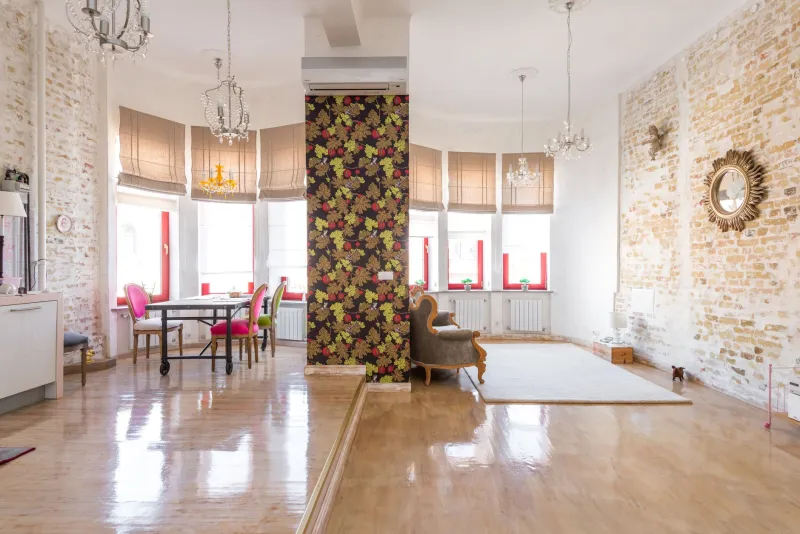
There's a reason the most interesting people you know live in apartments that look like they were designed by someone who lost a bet. The so-called "dead zones" — those weird half-rooms, jutting alcoves, and corridors that lead nowhere obvious — aren't flaws. For a growing number of creative professionals, they're the whole point.
Walk through enough open houses in cities like Chicago, Brooklyn, or Portland and you'll start to notice a pattern. The apartments with the clean sight lines, the logical bedroom placements, the sensible kitchen triangles? Those get snapped up by people who want their space to function like a spreadsheet. But the ones with the inexplicable bump-out near the bathroom, the sunken living room that makes zero ergonomic sense, the hallway that's somehow also a room — those linger. Until, suddenly, they don't. Because someone finds them and immediately understands.
The Psychology of the Constraint
Design psychologist and spatial consultant Renata Osei has spent years studying how physical environments shape cognitive behavior. Her work keeps circling back to one counterintuitive finding: the more a space resists easy categorization, the more creatively its occupant tends to think within it.
"When a space is perfectly optimized, your brain kind of clocks out," she explains. "Everything is where you expect it. There's no friction. But friction — the right kind — is actually where problem-solving begins. An awkward layout forces you to keep asking questions about your space. And people who are comfortable asking questions about their space tend to be comfortable asking questions about everything else, too."
This isn't just abstract theory. Architects and interior designers who work with artists and musicians have been observing it for decades, even if they didn't always have language for it. The dead zone — that liminal square footage that doesn't quite belong to any room — functions less like wasted space and more like a blank canvas that refuses to tell you what to do with it.
"I Didn't Choose This Apartment. It Chose Me."
Nashville-based songwriter and producer Delia Marsh has lived in the same East Nashville apartment for six years. The place is, by any conventional measure, a mess of spatial decisions. There's a narrow room off the main living area that the landlord charitably calls a "study" but is really more of a pressurized tube. The kitchen has a weird step down into it that has claimed at least three dinner party victims. The bathroom is inexplicably large.
"Every person I've brought here for the first time does this thing where they walk around with a slightly confused expression, like they're waiting for the apartment to make sense," Marsh laughs. "And then they get to my studio — which is that weird little tube room — and they completely understand."
Marsh records demos in that narrow space specifically because of its acoustic oddities. The way sound bounces off the close walls gives her rough recordings a texture she's never been able to replicate elsewhere. What a real estate listing would call a liability has become, in her words, "the whole reason anything I make sounds like me."
This is the pattern that keeps emerging when you talk to creative people about their living spaces. The apartment's strangeness doesn't just get tolerated — it gets incorporated. It becomes part of the work.
Dead Zones as Creative Infrastructure
Interior designer Marcus Tully, who specializes in working with artists and makers in the Pacific Northwest, has a term for the phenomenon: "productive resistance." His philosophy is that the best creative environments aren't the ones that get out of the way — they're the ones that push back just enough.
"A blank white box is great for a gallery. For actually living and making things, it can be kind of deadening," Tully says. "The apartments I find most exciting to work with are the ones where the architecture has opinions. Where there's a weird corner that you have to have a conversation with. Those constraints become a collaborator."
His approach to dead zones is to resist the urge to "solve" them in any conventional sense. Instead, he asks his clients what the space wants to be — a question that sounds a little woo-woo until you realize it's really asking: what does this configuration make possible that a normal room wouldn't?
Sometimes the answer is a reading nook so tucked-away it becomes genuinely private. Sometimes it's a photography corner where the weird light hits differently than anywhere else in the apartment. Sometimes it's just a place to put the weird stuff — the collections, the works-in-progress, the objects that don't fit any category — which turns out to be exactly what a creative life needs most.
The Rejection Filter
There's another dynamic worth naming here, one that's less about psychology and more about self-selection. Apartments with challenging layouts tend to repel people who need their space to broadcast conventional success. The open-concept, stainless-steel-appliance, clean-lines crowd has options. They will find what they're looking for.
But the person who walks into an apartment with a load-bearing pillar in the middle of the living room and thinks, huh, I could build a reading bench around that — that person is already thinking differently. The space doesn't just attract creative people. It filters for them.
Writer and essayist Jerome Kwan, who lives in a pre-war Chicago apartment with a hallway that branches in a direction that makes no architectural sense, puts it plainly: "I've never been able to live in a space that felt finished. If everything is already solved, what am I doing here? The weird hallway is basically a metaphor for how I approach everything. I don't know where it goes. That's kind of the whole thing."
Embracing the Unloved Room
If you're currently living with a dead zone — that space you've been ignoring, apologizing for, or covering with a plant — consider this your invitation to stop trying to fix it and start trying to understand it. What does it make difficult? What does it make possible? What kind of thinking does it invite?
The most innovative apartments aren't the ones that got renovated into submission. They're the ones whose occupants decided the weirdness was the feature, not the bug. And if you've found yourself drawn to a floor plan that made everyone else walk away? You might already know exactly what to do with it.