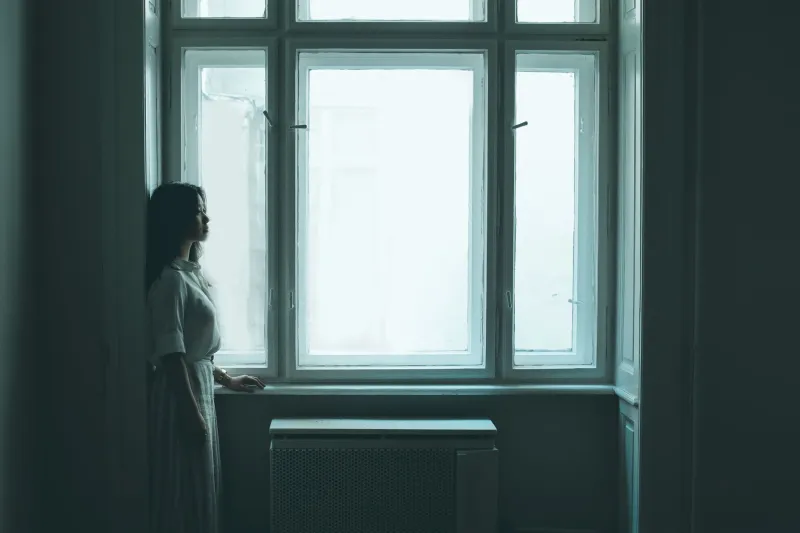
Most people describe apartment hunting the way they'd describe a root canal — necessary, unpleasant, and something you endure rather than enjoy. You scroll listings at midnight, you attend open houses that smell like someone else's lunch, you do the math on square footage versus sanity approximately forty times. And then, sometimes, you walk into a place and something in your chest just... settles.
Not "this will do." Not "I guess I could make it work." Something quieter and stranger than either of those things. Something that feels, if you're willing to say it out loud, like recognition.
The Moment You Can't Quite Explain
Denise Okafor, a textile artist based in Portland, Oregon, had been searching for a new studio apartment for three months when she walked into a second-floor unit in a converted warehouse in the Alberta Arts District. The building had good bones, decent light, fine rent. Nothing spectacular on paper.
"But the walls," she says. "They were this exact shade of terracotta that I'd been using in my work for the past year. Not close to it. That color. And there were these deep windowsills — almost a foot wide — that were perfect for drying fabric. I hadn't even told the landlord I was a textile artist. I don't think it would have mattered to him. But it mattered to me."
She signed the lease the same day.
This is the kind of story that's easy to dismiss. Confirmation bias, you might say. She noticed the things that fit and filtered out the things that didn't. And sure — maybe. But ask anyone who's had a version of this experience and they'll push back, gently but firmly, on that explanation. Because the feeling isn't just "this works for me." It's "this was arranged for me," which is a subtly, meaningfully different thing.
When the Layout Knows Something You Don't
Marco Reyes had spent fifteen years working in corporate finance in Chicago before a slow, creeping restlessness pushed him toward food. Not as a hobby — as a vocation. He'd started doing pop-up dinners on weekends, taking fermentation classes, obsessively reading food writing. He wasn't sure yet whether this was a phase or a future.
Then he found his apartment in Logan Square.
"The kitchen was enormous," he says. "Like, absurdly large for the unit. It took up almost a third of the floor plan. The previous tenant had apparently been a caterer. There was a six-burner range already installed, extra ventilation, a prep island. For the rent I was paying, it made no financial sense — the landlord basically hadn't updated the listing in years and had no idea what he had."
Marco moved in with one foot still in finance. Within eight months, he'd left his job. He now writes a food newsletter with over 40,000 subscribers and is working on a cookbook proposal. "I think about that kitchen a lot," he says. "Like — what if I'd found a normal apartment? Would I have made the jump? I honestly don't know."
It's a question worth sitting with. Not because apartments have agency, exactly, but because the spaces we inhabit shape the stories we tell ourselves about who we are and what's possible. A kitchen that says you could do something serious here is a different psychological environment than a kitchenette that says heat up your leftovers and go to bed.
The Science-Adjacent Answer (And Why It's Not the Whole Story)
Environmental psychologists have spent decades studying how physical spaces influence mood, cognition, and identity. We know that natural light affects serotonin. We know that ceiling height correlates with abstract thinking. We know that clutter competes for cognitive bandwidth and that certain color temperatures make us feel calmer or more energized.
What this research doesn't fully account for is the timing dimension — the uncanny way that people seem to find spaces that match not just their current self but their becoming self. The apartment that suits who you're turning into, not just who you already are.
Carla Mendenhall, a therapist in Austin, Texas, who also happens to be an amateur architectural history enthusiast, has a theory about this. "I think when we're in a period of transition — even an unconscious one — we become more attuned to environmental signals," she says. "We're already scanning for possibility. So we're more likely to notice a space that offers it. Whether that's intuition or just heightened attention, I'm not sure the distinction matters as much as we think it does."
She pauses. "Though I'll admit — I found my own house the week after I decided to go into private practice. It had a room off the main entrance that was completely separate from the rest of the living space. Perfect for a home office with a private entrance for clients. I hadn't been looking for that. I didn't know I needed it. But there it was."
What "Waiting" Actually Means
None of this requires you to believe in fate, or cosmic architecture, or that your landlord is secretly a psychic. What it requires is a willingness to take seriously the idea that humans are not purely rational actors when it comes to space — that we bring our whole selves, including the parts we haven't fully met yet, into the search.
Apartments accumulate history. They carry the energy — if you'll allow the word — of everyone who shaped them, modified them, lived their weird and specific lives inside them. A kitchen expanded by a caterer doesn't just offer counter space; it offers a kind of permission. A wall painted by someone who loved a particular color doesn't just affect the light; it offers a kind of conversation.
When we walk into a space that feels like it was waiting for us, maybe what we're actually experiencing is a moment of unusual clarity — a flash where the apartment's accumulated past and our own unfolding future briefly line up and we're paying just enough attention to notice.
Or maybe it's something more mysterious than that. Either way, the feeling is real. The effect is real. And the life you build inside that space — the one that somehow fits in a way you couldn't have predicted — that's real too.
How to Actually Find the Apartment That Finds You
If you're currently in the trenches of apartment hunting, a few things worth trying:
Don't just assess. Inhabit. Stand in the center of a room and close your eyes for ten seconds. What does the space feel like when you stop evaluating it?
Look for the weird specifics. Not the granite countertops or the subway tile backsplash — those are staging. Look for the oddities: the extra-deep closet, the strange built-in, the window that faces exactly the right direction. Those are the things left by a real life.
Notice what you notice first. Not what impresses you — what you see. Your eye goes somewhere before your brain catches up. That instinct is data.
Ask yourself who this apartment was made for. And then ask whether that person is someone you're becoming.
You might be surprised how often the answer is yes.
Apartment Number 9 believes that odd spaces inspire extraordinary lives — and sometimes, they know it before you do.